


If you’re researching nimbus hosting reviews, the direct answer is this: Nimbus is a premium, agency-focused managed hosting provider built for performance, scalability, and workflow efficiency , but recent service feedback has been mixed.
From my analysis, Nimbus stands out for its powerful multi-site dashboard, WordPress and Magento optimisation, and developer-friendly tools. However, pricing is premium, and some recent users have raised concerns about support consistency and downtime following operational changes.
Here’s a quick overview of what I found:
- Built specifically for agencies and freelancers
- Strong WordPress, Magento, and PHP hosting support
- Centralised multi-site management dashboard
- Premium pricing structure (£39+ per month)
- Mixed recent reviews regarding support and stability
Overall, Nimbus suits performance-focused agencies, not beginners seeking budget hosting.
What Is Nimbus Hosting, And What Services Does It Offer In The UK?
Nimbus Hosting is a UK-based managed cloud hosting provider specialising in high-performance ecommerce hosting and scalable cloud servers.
Unlike traditional shared hosting providers, Nimbus focuses on:
- Managed cloud hosting
- WooCommerce hosting
- Magento hosting
- Cloud VPS solutions
- Dedicated cloud environments
- Proactive support and monitoring
Their services are primarily aimed at:
- E-commerce businesses
- Digital agencies
- High-traffic websites
- Growing UK brands
What makes them different from mass-market hosts is their fully managed approach. Instead of just renting server space, Nimbus actively manages, monitors, and optimises your hosting environment.
What Are The Top Features Highlighted In Nimbus Hosting Reviews?
1. Managed WordPress Hosting Built for Efficiency
One of the first things that stands out to me is Nimbus’s managed WordPress hosting. This isn’t just WordPress installed on a shared server, it’s structured around performance and workflow efficiency.
From what I’ve reviewed, the platform includes built-in WordPress tools, site cloning, managed updates, and server-level optimisation. If I were managing 15–30 WordPress client sites, this would significantly reduce the time I spend configuring caching plugins or troubleshooting slow back-end dashboards.
What I particularly like is the idea of reducing technical overhead. As someone focused on client delivery, I don’t want to constantly manage server tuning. A managed environment removes that friction.
However, I’m also realistic. If I were only running one small brochure website, I’d struggle to justify the premium monthly cost. This hosting is clearly built for scale and workload efficiency, not budget savings.
2. Magento 2.4 Optimised Infrastructure
Magento hosting is where Nimbus positions itself as more specialised than many competitors.
Magento is demanding. I’ve seen poorly configured servers cause slow category pages and frustrating checkout delays. Nimbus integrates performance elements such as Varnish caching, Elasticsearch, and PCI-compliant infrastructure, all essential for serious ecommerce.
If I were running a Magento store generating consistent revenue, I would feel more comfortable knowing the hosting stack is built specifically for Magento rather than adapted as an afterthought.
That said, I would still want clarity on how customisation works for complex builds. Large Magento stores often require tailored server setups. No hosting provider is entirely “hands-off” at that scale.
From my perspective, Nimbus at least understands Magento’s technical requirements, which is reassuring.
3. Centralised Multi-Site Agency Dashboard
This is the feature that genuinely appeals to me as someone reviewing platforms for agencies.
Nimbus offers a centralised dashboard where I can manage all client websites in one place. Instead of juggling multiple logins and scattered tools, I could:
- Assign team permissions
- Clone sites
- Deploy using Git
- Monitor performance metrics
- Receive Slack notifications
If I were running an agency handling dozens of websites, this would dramatically improve operational efficiency. Even saving 10 minutes per site per week adds up quickly across a portfolio.
What I appreciate most is that the platform appears built with agencies in mind, not retrofitted from consumer hosting software.
However, I’ve also noticed recent reviews mentioning reduced root access after migrations. As someone who values flexibility, I would want to clarify exactly how much server-level control I retain.
The dashboard is powerful, but flexibility matters too.
4. High-Performance Cloud Infrastructure

Nimbus promotes a 99.995% uptime guarantee and claims it is 400% more capable during traffic spikes. On paper, the server specifications are strong for this pricing tier.
Entry plans include solid resource allocations, multiple CPU cores, dedicated memory, SSD storage, and structured monthly page view allowances.
Historically, many users praised fast load times and strong Core Web Vitals performance. If performance is critical to my clients’ SEO rankings and ecommerce conversions, that’s a strong advantage.
However, I can’t ignore the recent 2025–2026 reviews reporting downtime and outages. Even if those cases are isolated, they matter especially for agencies whose reputation depends on site reliability.
If I were onboarding a revenue-generating ecommerce site, I would run independent uptime monitoring alongside Nimbus’s guarantee. I prefer verification over assumptions.
The infrastructure looks capable. The real question is operational consistency.
5. Free Migrations and Onboarding Support
Migration support is another feature that initially impressed me.
Depending on the plan, Nimbus offers multiple free site migrations. For an agency moving 10–20 client sites, that represents a meaningful saving in both time and risk.
A professionally managed migration reduces the likelihood of DNS errors, SSL issues, or database misconfigurations. From a workflow standpoint, that’s valuable.
Earlier reviews strongly praised migration smoothness and onboarding speed.
However, I’ve also read more recent reviews describing complications during forced server migrations. Some users reported downtime or backup inconsistencies.
If I were migrating sites today, I would:
- Schedule migrations carefully
- Confirm rollback procedures in writing
- Test backups before going live
Migration support is a strong feature in principle. I would simply approach it with structured planning rather than blind trust.
6. Dedicated Servers with Custom Hardware Options

One feature I find particularly appealing is the availability of dedicated servers. Unlike shared or semi-managed cloud hosting, a dedicated server gives full resource allocation for specific client projects.
If I were handling:
- A high-traffic ecommerce brand
- A complex Magento build
- A large multi-site WordPress network
I would want hardware customisation and isolated resources. Nimbus allows agencies to configure higher specifications for enhanced performance and scalability.
That level of control is valuable because it removes “neighbour site” performance risks common with shared hosting.
However, dedicated infrastructure significantly increases cost. I would only consider this route if client revenue justifies the investment.
7. Backup & Security Infrastructure
Security is non-negotiable for me, especially when managing e-commerce sites.
Nimbus includes:
- SSL support
- 14-day backup retention
- On-demand backups
- PCI compliance for e-commerce
- Built-in WooCommerce and Magento compatibility
From a structural standpoint, these are strong inclusions for agency-level hosting.
However, I can’t ignore the recent negative reviews mentioning backup restore problems during server migrations. Even if those situations were isolated, I would personally test restore functionality myself before relying on it fully.
Security features exist, but execution consistency is what matters most in real-world scenarios.
8. Carbon Neutral Hosting

This is a feature I actually appreciate more than I expected.
Nimbus promotes its hosting as carbon-neutral. For agencies working with sustainability-conscious brands, this becomes a meaningful talking point.
In today’s climate-aware business environment, being able to say that hosting aligns with environmental values can strengthen proposals and client positioning.
It doesn’t directly impact performance, but it does enhance brand credibility — especially when pitching to eco-focused organisations.
9. Developer Tools & Flexibility
As someone reviewing hosting platforms from a technical workflow perspective, I value developer flexibility.
Nimbus includes:
- Git deployment
- Site cloning
- Team management with user permissions
- Slack notifications
- WordPress-specific admin enhancements
For development teams, these tools streamline collaboration. Instead of manual FTP uploads and fragmented deployment processes, Git integration modernises workflow.
That said, I’ve read recent user comments about reduced root access after certain migrations. For developers who require full server-level control, this could be a limitation.
So while the tools are strong, I would want clarity on how much backend control remains accessible.
10. Technical Support & SLA Claims

Support is arguably the most important feature for agencies.
Nimbus promotes:
- 97% of support tickets answered within 1 hour
- 60-second average phone hold time
- 89% of migrations completed within one day
- A historical 4.9-star Google rating
Older reviews strongly support these claims. Many long-term customers praised knowledgeable UK-based staff and quick resolutions.
However, more recent reviews paint a different picture. Several users report:
- Slower ticket handling
- Being directed to ticket systems instead of receiving direct phone support
- Inconsistent technical depth
- Offshore support concerns
For me, this is the most critical consideration.
A hosting platform can have excellent infrastructure, but if support responsiveness declines, agencies feel the impact immediately.
If I were considering Nimbus today, I would test support directly before committing perhaps with a pre-sales technical query to gauge current responsiveness and expertise.
What Do Real Users Say About Nimbus?

⭐⭐⭐⭐⭐ 5/5 – “The Best Support We’ve Ever Had”
Martin P. – Web Design Agency Owner, Birmingham
“We’ve been with Nimbus for years and the support used to be absolutely outstanding. Tickets answered quickly, knowledgeable staff, and real people on the phone. The dashboard makes managing all our client sites simple. For agencies, it’s a brilliant system.”⭐⭐⭐⭐⭐ 5/5 – “Built For Agencies Like Ours”
Louise T. – Digital Marketing Consultant, Bristol
“The multi-site management platform is a huge time saver. I can clone sites, manage permissions, and deploy changes without jumping between systems. It genuinely feels like it was designed for agencies rather than general consumers.”⭐⭐⭐⭐☆ 4/5 – “Fast Hosting, Premium Price”
Daniel R. – Ecommerce Store Owner, Manchester
“Our WooCommerce site runs quickly and handles traffic spikes far better than our previous host. It’s not cheap, but performance has been solid overall. If your website generates revenue, it’s worth considering.”⭐⭐⭐⭐☆ 4/5 – “Strong Platform, But Keep Communication Clear”
Hannah L. – Freelance Developer, Leeds
“The platform itself is powerful and developer-friendly. Git deployment and staging tools are excellent. I’d just recommend clarifying exactly what’s included in your plan before signing up.”⭐⭐☆☆☆ 2/5 – “Used To Be Excellent”
David B. – Agency Director, London
“Nimbus used to be fantastic. Support was fast and reliable. Over the past year, response times have slowed and we’ve experienced unexpected downtime. It’s disappointing because the platform itself is good.”⭐☆☆☆☆ 1/5 – “Downtime & Migration Issues”
Alex M. – Web Agency Owner, Glasgow
“We were forced onto a new server during migration and experienced several outages. Backup restores didn’t work as expected, and support wasn’t as responsive as it once was. We’ve started moving sites elsewhere.”⭐☆☆☆☆ 1/5 – “Billing Confusion After Acquisition”
Andy S. – Digital Agency, Nottingham
“We’ve spent months trying to close old servers and clarify invoices. Communication has been inconsistent. It’s frustrating because we were loyal customers for years.”
Nimbus Plans & Pricing Table
When I review Nimbus Hosting reviews, pricing is one of the most frequently discussed topics. Nimbus does not position itself as a budget host — it is clearly targeting agencies, freelancers, and ecommerce businesses that prioritise performance and workflow efficiency over low monthly costs.
Below is a simplified breakdown of the current core managed hosting tiers offered by Nimbus Hosting.
Managed Hosting Plans Overview
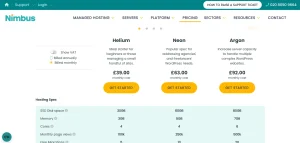
Plan Monthly Cost SSD Storage Memory CPU Cores Monthly Page Views Free Migrations Best For
Helium £39 30GB 3GB 4 100k 5 Freelancers or small agencies
Neon £63 60GB 5GB 4 250k 10 Growing WordPress agencies
Argon £92 80GB 7GB 6 500k 20 Multi-site or complex ecommerce
All plans include:
- SSL support
- 14-day backup retention
- On-demand backups
- PCI compliance
- WooCommerce & Magento compatibility
- Unlimited users with team permissions
- Git deployment and site cloning tools
- Carbon-neutral hosting
What I Notice About Nimbus Pricing?
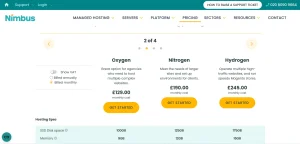
From my perspective, Nimbus pricing reflects infrastructure allocation rather than “unlimited everything” marketing. Page view limits, memory, and CPU cores are clearly defined, which I actually appreciate because it sets expectations.
However, compared to entry-level shared hosting providers, £39 per month as a starting point is premium. If I were managing just one low-traffic website, this would feel excessive.
Where the value starts to make sense is for:
- Agencies handling multiple client sites
- E-commerce stores with consistent traffic
- Developers needing Git and staging tools
- Businesses that prioritise uptime and performance
Another important consideration is scalability. Moving from Helium to Neon or Argon is straightforward, allowing agencies to increase capacity as client portfolios grow.
That said, based on recent user feedback in some Nimbus hosting reviews, I would also clarify:
- Billing cycles and renewal terms
- Server migration policies
- Resource overage handling
Pricing itself is transparent at the plan level. The key is ensuring operational clarity before long-term commitment.
Is Nimbus Worth The Price?
If I compare Nimbus purely on cost, it is not the cheapest option in the UK market.
If I compare it to:
- Agency tooling
- Managed optimisation
- Developer features
- E-commerce readiness
The pricing becomes more understandable.
For freelancers managing a handful of client sites, Helium could be justified. For larger agencies, Neon or Argon likely offer better resource-to-site ratios.
Ultimately, Nimbus pricing aligns with its positioning: managed, agency-focused, performance-driven hosting — not entry-level consumer hosting.
When I analyse Nimbus Hosting reviews, I don’t see a simple “good” or “bad” hosting provider. Instead, I see a technically strong platform with a clear agency focus, but also a provider that has experienced mixed feedback in recent years.
Here’s my balanced breakdown of the pros and cons of using Nimbus Hosting.
What Are The Pros And Cons Of Using Nimbus For Your Website?

The Pros of Using Nimbus
1. Built Specifically for Agencies
One of the biggest advantages, in my view, is that Nimbus feels designed for agencies and freelancers managing multiple client websites.
The centralised dashboard allows me to:
- Manage multiple sites in one place
- Assign team permissions
- Clone and stage websites easily
- Use Git deployment tools
For agencies, this dramatically improves workflow efficiency.
2. Strong WordPress & Magento Optimisation
Nimbus doesn’t treat e-commerce as an afterthought. Its infrastructure is optimised for:
- WooCommerce
- Magento 2.4
- PHP-based CMS platforms
For revenue-generating ecommerce sites, this focus on performance and compatibility is a genuine strength.
3. Defined Resource Allocation
Unlike some shared hosting providers that advertise “unlimited” everything, Nimbus clearly outlines:
- SSD storage
- Memory
- CPU cores
- Page view allowances
I personally prefer this transparency because it sets realistic expectations around capacity.
4. Developer-Friendly Tools
Git deployment, site cloning, Slack notifications, and team permissions make Nimbus attractive to development-focused teams.
For agencies handling complex builds, this is far more efficient than traditional cPanel environments.
5. Carbon Neutral Hosting
For businesses that care about sustainability messaging, Nimbus’s carbon-neutral positioning adds brand value. While it doesn’t directly impact performance, it can be meaningful in client proposals.
The Cons of Using Nimbus
1. Premium Pricing
The starting price of £39 per month makes Nimbus significantly more expensive than entry-level shared hosting providers.
If I were running a single low-traffic site, I would likely find better value elsewhere.
Nimbus is built for scalability and workload efficiency — not budget hosting.
2. Mixed Recent Support Reviews
Historically, support was widely praised.
However, more recent Nimbus hosting reviews report:
- Slower response times
- Inconsistent ticket handling
- Frustration during server migrations
- Reduced direct phone support in some cases
For agencies, support reliability is critical. Even a strong platform can feel weak if communication declines.
3. Reported Downtime in Recent Reviews
Nimbus advertises high uptime, yet some 2025–2026 users have reported:
- Unexpected downtime
- Prolonged outages
- Backup restoration issues
While these may not represent every customer’s experience, they are significant enough to warrant careful monitoring.
4. Possible Migration & Billing Frustrations
Some long-term users have reported:
- Confusion during forced server migrations
- Difficulty cancelling old services
- Billing clarification delays
If I were signing up today, I would clarify all billing and migration terms upfront.
How Does Nimbus Compare to Other Popular Platforms?
When I analyse Nimbus hosting reviews, I always remind myself that Nimbus is not trying to compete with entry-level website builders. It’s a managed hosting platform built primarily for agencies, developers, and e-commerce businesses.
To give you a clearer picture, here’s how Nimbus Hosting compares with five well-known platforms in the UK market.
Nimbus vs Wix
Nimbus is a managed hosting platform designed for agencies and developers who already build websites using WordPress, Magento, or custom PHP applications. Wix Hosting, on the other hand, is a beginner-friendly website builder focused on drag-and-drop design flexibility.
Feature Nimbus Wix
Website Builder No built-in builder (host your own CMS) Drag-and-drop builder
Target User Agencies & developers Beginners & creatives
Ecommerce WooCommerce & Magento ready Built-in ecommerce tools
Server Control Managed cloud infrastructure Fully managed, no backend control
Best For Agencies managing multiple sites Individuals building their first website
Nimbus vs SiteGround
SiteGround is known for managed WordPress hosting with strong support and competitive pricing. Nimbus positions itself more narrowly toward agency workflows.
Feature Nimbus SiteGround
Pricing Premium (£39+ per month) Mid-range
Dashboard Agency-focused multi-site platform Custom Site Tools
WordPress Optimisation Advanced, agency-focused Strong, user-friendly
Magento Support Yes Limited
Best For Agencies & ecommerce builds Small businesses & bloggers
Nimbus vs Kinsta
Kinsta is a premium managed WordPress hosting provider built on Google Cloud infrastructure. This is closer to Nimbus in pricing and positioning.
Feature Nimbus Kinsta
Focus WordPress, Magento, PHP apps WordPress only
Infrastructure Managed cloud Google Cloud Platform
Agency Tools Multi-site & team permissions Agency dashboard tools
Developer Features Git, cloning, Slack alerts Staging & DevKinsta
Best For Agencies needing flexibility High-performance WordPress sites
Nimbus vs IONOS
IONOS is popular in the UK for affordable hosting and dedicated support consultants.
Feature Nimbus IONOS
Entry Pricing Premium Budget-friendly
Infrastructure Managed cloud for agencies Shared, VPS & dedicated
Support Model SLA-driven support Personal consultant model
Developer Tools Git, staging, cloning Basic developer tools
Best For Agencies scaling client sites SMEs & startups
Nimbus vs Krystal
Krystal is a UK-based hosting provider known for eco-friendly hosting and strong customer support.
Feature Nimbus Krystal
Hosting Type Managed cloud Shared, VPS & managed
Sustainability Carbon neutral positioning 100% renewable energy
Agency Tools Advanced multi-site platform More traditional hosting dashboard
Pricing Higher starting cost More flexible entry plans
Best For Agencies & ecommerce specialists UK businesses seeking ethical hostin
Conclusion
After reviewing multiple Nimbus hosting reviews, I see Nimbus as a technically strong, agency-focused hosting platform with powerful tools for WordPress, Magento, and multi-site management.
Its infrastructure, developer features, and scalability make it well-suited to growing agencies and e-commerce brands.
However, recent mixed feedback around support consistency and operational changes means I would approach with careful evaluation.
For performance-driven businesses, Nimbus remains compelling, but due diligence and clear communication are essential before committing.
FAQs About Nimbus Hosting
Is Nimbus Hosting only for e-commerce websites?
No. While it specialises in e-commerce hosting, it can support any performance-driven website.
Does Nimbus Hosting offer shared hosting?
No. Nimbus focuses on managed cloud infrastructure rather than traditional shared hosting.
Is Nimbus Hosting suitable for WordPress?
Yes. Especially WooCommerce-based WordPress sites.
Can I migrate my existing website to Nimbus?
Yes. They provide migration assistance as part of onboarding.
Does Nimbus Hosting provide UK-based support?
Yes. Support is UK-focused and technically experienced.
Is Nimbus Hosting good for agencies?
Yes. Agencies benefit from scalable cloud solutions and proactive management.
Does Nimbus Hosting include backups?
Yes. Managed plans include automated backup solutions.