


If you’re deciding between WordPress and Shopify for your eCommerce business, here’s my honest answer: WordPress is the better long-term choice for flexibility, SEO, and control especially if you want to scale or customise deeply. Shopify, however, is the easier and faster option for launching an online store without technical hassle.
I’ve built and managed websites on both platforms for UK-based clients, and each has strengths depending on your goals and growth plans. Below, I break down how they stack up in every critical area.
Key Points:
- WordPress offers better SEO, plugin freedom, and content control.
- Shopify is faster to launch and easier to manage.
- WordPress scales better for long-term business growth.
- Shopify is ideal for simple stores and beginners.
- WordPress excels in affiliate marketing and custom workflows.
- Shopify includes hosting, security, and 24/7 support.
- In 2026, WordPress leads in scalability, while Shopify dominates ease-of-use.
What’s the Key Difference Between WordPress and Shopify for eCommerce?
When it comes to building an online store, WordPress and Shopify offer very different approaches. WordPress, paired with WooCommerce, is open-source and self-hosted. This means you’re in charge of setting up hosting, installing the CMS, and configuring your store from the ground up. In contrast, Shopify is a fully hosted, all-in-one eCommerce platform that’s ready to go as soon as you sign up.
WordPress provides incredible flexibility. You can build anything you want, tweak every setting, and scale however you see fit. But it requires more time, technical skill, and effort to set up. Shopify simplifies all of this. It handles hosting, security, updates, and even payment processing with built-in tools.
My experience has been that WordPress is ideal for those who want to control every aspect of their store or plan to scale significantly over time. Shopify, meanwhile, is perfect if you’re looking for a smooth, guided setup and minimal maintenance.
Best Option for Platform Control: WordPress 🏆
I find it reassuring to know that with WordPress, I own the entire setup. From my product database to the server configuration, I have access to everything. That’s a level of freedom I value, especially when clients want something custom.
Which Platform Offers Better Value for Money – WordPress or Shopify?
When comparing WordPress vs Shopify in terms of value for money, the biggest difference comes down to control versus simplicity. Shopify offers a bundled, fixed-cost solution that’s great for ease and predictability. WordPress gives you flexibility in how much you spend, and when, making it ideal if you want to grow gradually without being tied to a monthly app ecosystem.
I’ve worked with both, and while Shopify pricing is easier to understand upfront, WordPress allows me to scale features and cost exactly as needed. Especially for UK users who want to manage costs carefully, WordPress offers better long-term value if you’re willing to do a bit more setup.
Let’s break down the pricing options available on both platforms and compare what you actually get for your money.
WordPress.com Pricing Plans (UK – Annual Billing)
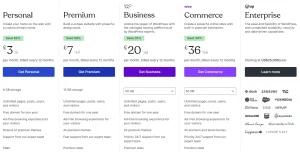
Plan Name Monthly Cost Storage Key Features Best For
Personal £3/month 6 GB Free domain (1st year), ad-free, premium themes, traffic stats, expert support Personal sites and blogs
Premium £7/month 13 GB All in Personal + advanced stats, Google Analytics, video upload, sitewide design customisation Freelancers and content creators
Business £20/month 50 GB All in Premium + plugin installation, priority 24/7 support, dev tools (SFTP, SSH), theme flexibility SMEs needing plugin access
Commerce £36/month 50 GB All in Business + WooCommerce-optimised hosting, store themes, eCommerce tools Full eCommerce stores
Enterprise Custom (£20k+ p.a.) Custom High-performance infrastructure, security, and enterprise features Large, complex eCommerce sites
WordPress lets you scale features and pricing gradually. You’re not locked into one ecosystem, plugins, hosting, and themes can be chosen independently or bundled depending on your goals.
What stands out is how each plan progressively adds essential functionality like Google Analytics, plugin support, WooCommerce enhancements, and developer-level tools. And all of it is managed by WordPress itself, which is a major plus.
Shopify Pricing Plans (UK – Annual Billing)
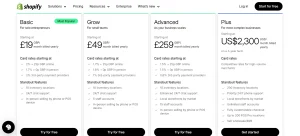
Plan Name Monthly Cost Card Rates (Online) Staff Accounts Key Features Best For
Basic £19/month 2.0% + 25p 1 10 inventory locations, 24/7 support, online & POS sales Solo entrepreneurs
Grow £49/month 1.7% + 25p 5 All in Basic + 5 staff, better card rates, local selling Small teams or growing brands
Advanced £259/month 1.5% + 25p 15 All in Grow + enhanced support, multi-storefronts, advanced reports Scaling stores with high volume
Plus From $2,300/month Custom rates Unlimited Fully custom checkout, B2B features, API control, wholesale & localisation Large retailers & enterprises
Shopify simplifies eCommerce with everything built-in, but each tier comes at a cost, especially when you factor in transaction fees, app subscriptions, and themes.
Card rates improve as you move up, but that also means higher base costs. Shopify Payments is required to avoid additional transaction fees; otherwise, third-party gateways will cost you up to 2% per transaction.
Best Option for Cost Control: WordPress 🏆
One of the reasons I lean towards WordPress is how customisable the costs are. I can spend as little or as much as I like, and avoid unnecessary expenses. With Shopify, recurring costs for apps and add-ons tend to build up quickly.
Which Is Easier to Use – WordPress or Shopify?
Ease of use is where Shopify often has the edge, especially for beginners. It’s designed so that anyone can set up a store without any technical knowledge. You choose a template, add your products, configure payment options, and you’re ready to go live.
WordPress has made significant improvements with the Gutenberg block editor and tools like Elementor. However, there’s still a learning curve, particularly when it comes to managing hosting, installing plugins, and troubleshooting issues.
From my personal experience, setting up a Shopify store takes just a few hours. WordPress takes longer, but once it’s all set up with a good theme and page builder, it becomes very intuitive.
Best Option for Beginners: Shopify 🏆
For clients with no web development experience, Shopify is my go-to recommendation. It saves time and reduces stress, especially when time to market is critical.
How Do WordPress and Shopify Compare in Design and Customisation?
Design and customisation capabilities are essential, especially for brands looking to differentiate themselves.
WordPress gives you full control over layout, fonts, colours, functionality, and page structure.
You can use advanced page builders like Elementor or Divi to build complex layouts, or modify your theme code directly using PHP, CSS, and JavaScript.
Shopify themes look great out of the box and are mobile responsive, but editing them beyond what’s offered in the theme editor requires knowledge of Liquid, Shopify’s templating language. It also limits control over certain page types unless you upgrade or use a third-party app.
Table 2: Design & Customisation Features
Feature WordPress Shopify
Themes & Templates 10,000+ free and premium options 100+ professionally designed themes
Drag-and-Drop Page Builders Elementor, WPBakery, Divi Basic customiser, limited flexibility
Code Access Full HTML, CSS, JS, and PHP Liquid templating, limited file access
Custom Fonts & Assets Fully customisable Limited without third-party apps
Visual Effects & Animations Supported via plugins or themes Some included in premium themes
Best Option for Design Freedom: WordPress 🏆
I enjoy the creativity WordPress allows. Whether I’m designing for a fashion retailer or a tech brand, I can build exactly what the client envisions without compromise. Shopify restricts that freedom unless you know Liquid or hire a developer.
How Do Speed and Performance Compare Between WordPress and Shopify?
Speed and performance affect user experience, conversion rates, and SEO rankings. The main difference between WordPress and Shopify here is responsibility.
Shopify manages everything for you, while WordPress puts performance control in your hands.
Shopify sites are hosted on a global CDN and are optimised by default. This means even a brand-new store usually performs well without any setup. For beginners or small businesses, this is a big advantage.
WordPress performance depends heavily on hosting quality, theme choice, and optimisation. A poorly configured WordPress site can be slow, but a well-optimised one can be extremely fast.
Performance Responsibility Breakdown
Performance Area WordPress Shopify
Hosting User-selected Fully managed
Caching Plugin or server-based Built-in
CDN Optional (Cloudflare, BunnyCDN, etc.) Included globally
Speed Optimisation Manual but powerful Automatic
Performance Ceiling Very high High but capped
In real-world use, I’ve seen:
- Shopify loading faster straight out of the box
- WordPress outperform Shopify after optimisation
- Large WordPress sites handling traffic spikes better with the right hosting
WordPress allows performance tuning such as:
- Advanced caching
- Image optimisation
- Font loading control
- Server-level performance tweaks
Shopify limits how much you can customise performance, but that simplicity is exactly why many people like it.
Best Option for Out-of-the-Box Speed: Shopify 🏆
If I need a fast store with zero configuration, Shopify wins. But when performance becomes critical at scale, I prefer WordPress because I can fine-tune everything rather than rely on a fixed system.
What Does the Market Share Say – Is WordPress or Shopify More Popular?
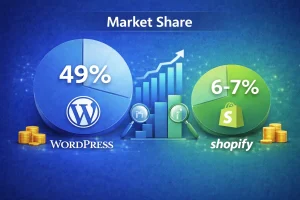
Market share gives valuable insight into platform trust, adoption, and long-term viability. Looking at the data, WordPress and Shopify dominate different areas of the web, but WordPress remains far ahead overall.
WordPress powers nearly half of all websites globally. That includes blogs, business websites, and eCommerce stores. WooCommerce alone accounts for a significant share of online shops worldwide.
Shopify has grown rapidly, particularly in eCommerce, and is now one of the most popular platforms for online stores.
Its growth has been driven by ease of use and aggressive marketing towards entrepreneurs and small businesses.
Global Market Share Overview (2025)
Platform Share of All Websites Share of eCommerce Sites Primary Strength
WordPress ~49% ~20% (WooCommerce) Flexibility & ecosystem
Shopify ~6–7% ~6–7% Hosted eCommerce
From what I see in the UK market:
- WordPress is common for content-heavy and SEO-focused sites
- Shopify is popular among DTC brands and dropshipping stores
- Many businesses start on Shopify and later move to WordPress
- Developers and agencies overwhelmingly support WordPress
Another important factor is ecosystem size. WordPress has:
- Tens of thousands of plugins
- A massive global developer community
- Easier access to affordable UK-based developers
- Open-source independence from a single company
Shopify, while stable and reliable, is proprietary. That means pricing, features, and limitations are controlled entirely by Shopify.
Best Option for Popularity and Ecosystem Strength: WordPress 🏆
I trust platforms with large communities and long-term adoption. WordPress’s dominance gives me confidence that it will remain supported, adaptable, and relevant for years to come.
What Are the Best Use Cases for WordPress and Shopify?
Each platform excels in different scenarios.
WordPress is ideal for:
- Content-rich sites (blogs, tutorials, resource hubs)
- Affiliate marketing and SEO-based sales funnels
- Custom functionality using plugins and APIs
- Sites expecting to scale significantly over time
Shopify is ideal for:
- First-time store owners with limited technical skills
- Simple eCommerce stores with fewer than 100 products
- Dropshipping stores using platforms like DSers
- Businesses that want a managed, no-fuss setup
Best Option for Versatile Business Models: WordPress 🏆
I’ve built blogs that evolved into affiliate stores, and client stores that became marketplaces all on WordPress. That kind of adaptability just isn’t possible on Shopify without expensive custom development.
Is WordPress or Shopify Better for Dropshipping and Affiliate Marketing?
If your business revolves around dropshipping or affiliate marketing, choosing the right platform becomes even more important.
I’ve built and worked on both types of sites using WordPress and Shopify, and I can confidently say they offer very different experiences.
Let’s start with dropshipping. Shopify is built with this in mind. Its ecosystem is designed for eCommerce from the ground up, and it integrates smoothly with major dropshipping apps like:
- DSers (official replacement for Oberlo)
- Spocket
- Printful
- Zendrop
These apps allow you to import products, set pricing rules, sync inventory, and automate fulfilment all from the Shopify dashboard.
This makes it extremely easy to launch a dropshipping store quickly with minimal setup.
However, these apps often come with monthly fees and limitations unless you’re on a higher Shopify plan. And if you want to run multiple dropshipping suppliers or expand globally, you’ll likely need additional paid plugins or custom development.
On the WordPress side, dropshipping is equally powerful, though a bit more hands-on. You can use:
- AliDropship (a one-time payment plugin)
- WooDropship
- Wholesale2B
- Manual CSV or API-based supplier integrations
WordPress gives you full control over your dropshipping model, allowing deeper customisation and a broader selection of supplier tools — especially if you’re working with smaller UK-based suppliers or niche European brands.
Now, let’s look at affiliate marketing and here, WordPress is the clear winner. Shopify does have affiliate app options, but it’s not designed to publish high volumes of SEO-rich content, which is the heart of affiliate strategy.
WordPress excels at:
- Managing large volumes of blog content
- Structuring posts into categories and tags
- Embedding affiliate links with tools like PrettyLinks or ThirstyAffiliates
- Using plugins like Ad Inserter or Lasso to optimise monetisation
- Building email capture funnels via integrations like Mailchimp or FluentCRM
Plus, with full SEO control, you can fine-tune every article and landing page to rank in search engines, which is often how affiliate revenue grows over time.
Table: Dropshipping & Affiliate Marketing Comparison
Feature WordPress Shopify
Dropshipping App Integration Wide variety, more custom options Excellent, with native apps (e.g. DSers)
One-time Plugin Cost Option Yes (e.g. AliDropship) No – monthly app fees
SEO for Affiliate Blogs Advanced control with plugins Limited content structure
Content Marketing Flexibility Unlimited (Gutenberg, Elementor) Product-focused layout
Link Cloaking & Tracking Built-in via plugins Requires paid apps
Best Option for Dropshipping & Affiliate Sites: WordPress 🏆
Shopify makes dropshipping easy for beginners, but WordPress gives me long-term flexibility and more monetisation control, especially when combining dropshipping with affiliate content. For affiliate marketing alone, WordPress is in a class of its own.
Do I Need WordPress If I Have Shopify?
This is a question I get quite often especially from Shopify store owners who want to start blogging or improve their content marketing. The answer depends on your goals, but in many cases, using both platforms together makes perfect sense.
If you already have a Shopify store and are happy with it, you might not “need” WordPress. Shopify provides basic blogging functionality, allows you to create static pages, and handles eCommerce extremely well.
But here’s where the limitations start to show:
- Shopify’s blogging system lacks advanced formatting, categories, and media management
- It doesn’t offer SEO plugins, schema control, or deep metadata editing
- Creating complex landing pages or lead-generation funnels is difficult without third-party tools
- It’s harder to build and manage large libraries of content (especially for affiliates or educators)
In contrast, WordPress is built for content. Many successful brands run their main eCommerce operations through Shopify, but maintain a separate WordPress site (or subdomain) for content and organic traffic growth.
For example:
- store.example.com is powered by Shopify
- blog.example.com is built on WordPress
This setup allows you to:
- Build out an SEO-rich blog that drives traffic
- Add lead magnets, quizzes, or content upgrades
- Promote affiliate offers in parallel to product sales
- Use powerful tools like Rank Math, Elementor, or ConvertBox
Another integration method is embedding Shopify Buy Buttons into WordPress posts or pages. I’ve used this approach for hybrid content-commerce strategies, and it works beautifully.
When I’d Recommend Adding WordPress to Shopify:
- You want to focus on content marketing and SEO
- You’re launching an affiliate blog or resource hub alongside your store
- You want more control over the blog layout, funnels, or custom content
- You’re scaling and want a dedicated content platform to grow traffic
Best Option for Hybrid Content-Commerce Sites: Both
While Shopify handles selling well, WordPress supercharges your marketing and organic reach. I’ve used this combo many times: Shopify for the checkout and product side, WordPress for blogging, lead capture, and affiliate content.
Which Platform Scales Better for Long-Term Growth?

If you’re building a business for the long term, you need a platform that can scale with your growth. That includes handling:
- More products
- More visitors
- More team members
- More integrations
- More complex workflows
Shopify is easy to scale operationally because everything is centralised and managed. As your business grows, you can move from the Basic plan to Advanced or even Shopify Plus. These upgrades include more staff accounts, better reporting, and additional sales tools like multi-location inventory or B2B selling.
However, as you move up the pricing ladder, the costs rise significantly, especially with Shopify Plus, which starts around £1,800+ per month. You’re also more reliant on apps and may face limitations with deeper customisation or integration unless you invest in Shopify’s headless commerce model.
WordPress offers unlimited scalability, but it’s entirely dependent on how you build and host it. I’ve managed WooCommerce stores with 50,000+ products and hundreds of thousands of monthly visitors. With quality hosting (like Kinsta, SiteGround Cloud, or WP Engine), WordPress can handle serious scale.
What I love about WordPress is that I can upgrade each part of the stack as needed:
- Choose faster hosting when traffic grows
- Add a CDN to improve performance globally
- Use database optimisation tools for large product inventories
- Deploy marketing automation using plugins or Zapier integrations
- Create custom dashboards, checkout flows, or multi-language support
You’re not locked into tiers, you pay only for the resources you need.
Scaling Feature Comparison
Scaling Feature WordPress Shopify
Product Catalogue Size Unlimited Scalable, but with limits on features
Staff & User Access Fully customisable Tied to plan tier
Hosting Resources Upgrade as needed Managed (fixed resources)
Checkout Customisation Full control Limited without Plus
Third-Party Integrations Open ecosystem Restricted API usage on lower plans
Cost Control at Scale Modular Gets expensive with higher plans
Best Option for Long-Term Scalability: WordPress 🏆
For serious growth, especially if you want flexibility over cost, performance, or features, WordPress gives me more freedom. Shopify scales well, but WordPress scales without limitations as long as you build it properly.
Which Platform Has the Better Plugin and App Ecosystem?
When comparing WordPress vs Shopify, one of the biggest deciding factors for most developers and me I’ve worked with is the ecosystem of plugins and apps. This is where WordPress clearly outshines Shopify in terms of scale, freedom, and flexibility.
Let’s start with WordPress. With over 59,000+ free plugins in the official repository, plus thousands of premium plugins available on third-party platforms like CodeCanyon, Elegant Themes, or directly from developers, there’s truly a plugin for everything.
Whether you need advanced SEO tools, booking systems, forums, affiliate link management, LMS integrations, or CRM workflows, WordPress plugins let you extend your site in ways that are limitless.
I’ve built everything from simple blogs to complex marketplaces using a plugin stack tailored to the exact needs of each project. And the best part? Many of these tools are free or offer one-time purchase options — no ongoing monthly fees.
Shopify, by contrast, has a smaller but more curated App Store, currently offering around 8,000 apps. Most of these are well-maintained and easy to install, covering essentials like reviews, upselling, inventory sync, email marketing, and shipping. However, many Shopify apps operate on monthly subscription models, which can quickly add up , especially as your store grows.
Another key difference is customisation. WordPress plugins allow full code-level access if needed. You can tweak functionality, adjust styling, or even build your own. Shopify’s apps are sandboxed within its proprietary framework, meaning you’re limited by what the app developer allows.
Summary:
- WordPress offers more plugins, greater customisability, and lower long-term cost.
- Shopify apps are easier to use, but often come with limitations and recurring fees.
Best Option for Plugin & App Flexibility: WordPress 🏆
For me, WordPress wins every time. The freedom to add, modify, or even build exactly what I need makes it unbeatable for long-term site growth and functionality.
How Are WordPress and Shopify Evolving in 2026?
As of 2026, both WordPress and Shopify have significantly expanded their plugin and app ecosystems — but in very different directions.
WordPress in 2026 is moving deeper into the world of modular, API-first development, with many plugin developers embracing headless architecture, AI-powered features, and block-based enhancements.
Plugins like Rank Math and Elementor now include AI-assisted content generation, performance optimisation, and predictive analytics.
WooCommerce has introduced more native integrations with third-party CRMs and POS systems, making it easier for businesses to unify offline and online operations.
What I’ve found especially powerful this year is the emergence of low-code plugin builders for WordPress, allowing agencies and solo developers like me to create lightweight, tailored functionality without relying on bloated third-party tools. The ecosystem is not only growing it’s maturing.
On the Shopify side, 2026 has seen big steps towards automation and AI integration within apps. Tools like Shopify Magic are now embedded into many apps by default, offering features like:
- AI-driven product descriptions
- Automated customer support flows
- Smart inventory and pricing suggestions
While Shopify’s App Store is still curated and relatively controlled, they’ve opened it up more in the past year to allow deeper API integrations especially for Shopify Plus users.
However, customisation is still gated behind platform restrictions, which means most merchants remain reliant on pre-built app functionality.
2026 Verdict
- WordPress plugins are becoming more intelligent, scalable, and developer-friendly.
- Shopify apps are becoming more automated and optimised for ease-of-use.
- WordPress remains the leader in flexibility; Shopify focuses on speed and simplicity.
If you’re planning for the future, WordPress gives you more room to grow, adapt, and innovate especially if you want to stay ahead in a competitive market.
Conclusion
Both WordPress and Shopify are powerful platforms, but the right choice depends on your goals. If you want full control, advanced SEO, and long-term flexibility, WordPress is the winner.
If speed, simplicity, and ease-of-use are your priorities, Shopify delivers. I’ve seen both platforms power thriving businesses but for those ready to grow, customise, and lead in 2026, WordPress is the ultimate weapon.
FAQs About WordPress vs Shopify
Is WordPress better than Shopify for eCommerce?
Yes, WordPress offers more flexibility, better SEO, and greater scalability.
Is Shopify or WordPress cheaper?
WordPress can be cheaper long-term, depending on hosting and plugins.
Is WordPress the best platform for affiliate marketing?
Yes, WordPress is far superior for content-driven affiliate sites.
Can Shopify handle SEO well?
Shopify handles basic SEO, but WordPress offers deeper optimisation tools.
Which is better for UK businesses?
Both work well in the UK, but WordPress offers better long-term value.
Can I migrate from Shopify to WordPress?
Yes, though some manual rebuilding is required.
Is Shopify faster than WordPress?
Shopify is faster by default, but WordPress can outperform it when optimised.