



Have you ever looked at a website address and instantly trusted it more because it ended in .com or .co.uk? I have, and most people do exactly the same thing without even realising it.
A domain extension may seem like a small detail, but it often shapes first impressions before someone even clicks on a website. When I see a familiar ending such as .com, .org or .uk, I usually feel more confident that the site is genuine.
Less familiar endings can sometimes make me hesitate, especially if I have never seen them before. That matters because trust influences whether people stay on a site, buy a product or share their details. So, which domain is most trusted? The answer depends on who the website is for, where the audience lives and what the website is trying to achieve.
Why Domain Extensions Matter for Website Trust?
A domain extension is the final part of a web address, such as .com, .org or .uk. Even though it is only a few characters long, it tells people something about the website before they visit it. I often notice that familiar domain endings make a site feel more reliable, while unusual ones can seem suspicious.
People usually judge a domain extension in four main ways. First, they look at whether they recognise it. Extensions such as .com and .org have existed for decades, so they feel familiar. Secondly, they think about location.
A .uk or .co.uk domain immediately suggests that a business serves the United Kingdom. Thirdly, people connect some extensions with a particular purpose. For example, .org is commonly linked to charities, while .com is associated with businesses.
Finally, trust affects behaviour. A familiar domain can encourage more clicks, enquiries and sales, while an unfamiliar one can make people leave. In other words, the right domain extension can help a website appear safer, more professional and more relevant to its audience.
Top 10 Most Trusted Domain Extensions Compared
Choosing the right domain extension is important because not every ending creates the same level of trust. Some domain extensions are recognised all over the world, while others are trusted mainly within a specific country. The ten domain endings below are among the best-known, but they are trusted for different reasons.
1. .com
The .com extension is still the most trusted domain in the world. I see it so often that it feels natural and familiar, which is exactly why most people trust it. Originally created for commercial websites, .com is now used by businesses, blogs, shops and personal brands.
People tend to remember .com websites more easily than any other type of domain. If someone forgets the exact address of a site, they often assume it ends in .com. That alone makes it look more reliable.
A recent industry study found that .com remains the number one trusted domain extension and is more memorable than any other option.
Key reasons why .com is trusted:
- It is the most recognised domain ending worldwide
- It works for businesses in any country
- People often assume a professional website uses .com
- It is easier to remember than many alternatives
One web expert explained it this way:
“.com is the #1 most trusted TLD. When people misremember a URL, they’re 3.8 times more likely to assume it ends in .com than anything else. That is why it still feels like the safest choice for most businesses.”
2. .org
The .org extension is usually trusted because it is strongly linked to charities, non-profit groups and educational projects. When I visit a website ending in .org, I often expect useful information rather than a business trying to sell something.
Although .org is not limited to charities, most people still associate it with organisations that aim to help, educate or support others. That can make it appear more honest and credible than a commercial domain.
However, .org only works well if the website matches that purpose. A business using .org instead of .com may confuse visitors and reduce trust.
- Best for charities and community projects
- Often trusted for educational or informational content
- Less suitable for online shops or commercial companies
- Creates an impression of transparency and purpose
According to a business comparison report:
“Both .org and .com are trusted by most internet users. The main difference is that people expect .org websites to belong to charities or organisations, while .com is expected for businesses.”
3. .de
The .de domain is the country-specific extension for Germany. It is one of the most trusted domain endings in Europe because German users often prefer websites that clearly appear local.
When a business uses .de, it tells German visitors that the company understands their language, currency and legal requirements. That creates confidence and can make people more willing to buy.
I would trust a German website with a .de ending more than a foreign domain if I were buying from Germany because it feels closer and more relevant.
- Highly trusted within Germany
- Shows a clear local presence
- Useful for businesses targeting German customers
- Less effective outside German-speaking markets
4. .br

The .br extension is used by websites in Brazil. Brazilian users often prefer local websites because they feel more familiar and easier to trust. A .br address can reassure visitors that the company operates in Brazil and understands local customers.
For businesses selling products or services in Brazil, using .br can make the site feel more genuine and easier to recognise. It can also help visitors believe that customer service, delivery and payments will be handled locally.
- Best for businesses serving Brazil
- Makes a company appear more local
- Encourages trust among Brazilian customers
- Less familiar to people outside Brazil
5. .ru

The .ru extension belongs to Russia. Although many legitimate Russian businesses use it, .ru sometimes has a weaker reputation internationally. This is largely because some spam and scam websites have used .ru addresses in the past.
That does not mean every .ru website is unsafe. Many trusted Russian organisations, technology firms and media companies still use .ru successfully. However, people outside Russia may be more cautious when they see it.
I have noticed that people often trust a .ru domain more when it comes from a known brand. Without a familiar company name, the domain can appear less reliable.
- Trusted inside Russia
- Sometimes viewed with caution internationally
- More trusted when linked to a recognised brand
- Often judged more harshly than .com or .org
A UK discussion about domain trust summed this up clearly:
“No domain gives me any immediate feeling of trust unless I know the website. Well-known extensions like .com, .co.uk, .org and .net feel normal, but I do not trust strange or unfamiliar endings at all.”
6. .uk
The .uk extension is one of the strongest choices for businesses serving the United Kingdom. When I see a .uk or .co.uk website, I immediately think that the company is British and easier to contact if there is a problem.
UK customers often trust local domains because they suggest that the business follows British laws, uses pounds and understands local needs. For many people, a .uk website feels more relevant than a .com one.
- Best for businesses serving the UK
- Builds trust with British visitors
- Helps customers feel that the company is local
- Particularly useful for small and medium-sized businesses
Research shows that British customers still prefer .uk and .co.uk domains when buying from UK businesses.
7. .net
The .net extension began as a domain for internet and technology companies. Today, it is still widely trusted, especially if the .com version is unavailable.
I usually see .net as a reasonable alternative, although it does not create the same instant confidence as .com. Many people still expect businesses to use .com first, so a .net address can sometimes feel like a second choice.
Even so, .net can work well for technology firms, hosting companies and software businesses.
- A good alternative when .com is unavailable
- Often used by technical or digital companies
- Familiar enough to be trusted
- Slightly less memorable than .com
8. .jp

The .jp extension is the country code for Japan. Japanese users generally trust .jp websites because they appear local and easier to understand.
A .jp website suggests that the business speaks Japanese, uses local payment methods and follows Japanese regulations. That matters because people usually trust local websites more than foreign ones when making purchases.
- Highly trusted in Japan
- Useful for local businesses and services
- Makes international brands appear more local
- Less recognisable outside Japan
9. .it
The .it extension belongs to Italy. It is trusted because it clearly shows that a business is connected to Italy and may provide local support, language and products.
For an Italian audience, .it often feels more relevant than .com. It can also help a company appear more authentic and easier to trust.
- Trusted by Italian users
- Useful for local shops and businesses
- Shows a strong Italian identity
- More effective in Italy than abroad
10. .fr

The .fr extension is the country-specific domain for France. French companies often choose it because it creates trust and local recognition.
When I see a .fr domain, I usually expect the website to be written in French and designed for customers in France. That can make visitors feel more comfortable and confident.
- Trusted within France
- Helps businesses appear local and reliable
- Strong choice for French-language websites
- Less suitable for international audiences
Which Domain Extension Is Best for a UK Business?
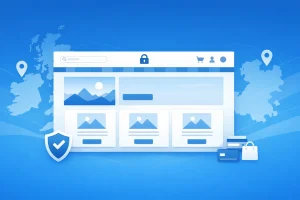
For a UK business, the best domain extension depends on who the website is trying to reach. If most customers are in Britain, a local domain usually feels more trustworthy. If the business plans to expand internationally, a global domain may work better.
Should I Choose .com or .uk for a UK Audience?
If I were building a website mainly for people in the UK, I would usually choose .uk or .co.uk first. British customers often trust local domains because they suggest the business is based in the UK and easier to contact.
A .com domain can still work in Britain, especially for larger or international brands. However, a .uk address often feels more familiar and local.
Choose .uk or .co.uk if:
- Most of your customers are in Britain
- You want the website to feel local
- You sell products or services mainly within the UK
Choose .com if:
- You want to reach customers worldwide
- You plan to expand beyond the UK
- Your brand already uses .com in other countries
Experts often recommend buying both versions and redirecting one to the other. That protects the brand and avoids confusion.
Does .co.uk Look More Trustworthy Than .uk?
The .co.uk ending is still the most familiar business domain in Britain. I personally think .co.uk feels slightly more established than .uk because people have seen it for longer.
A .uk address is shorter and more modern, so it appeals to newer businesses and technology brands. Younger users are becoming more comfortable with it, but some customers still trust .co.uk more because it has been around for years.
The difference is small, but there are a few patterns:
- .co.uk often feels more traditional and established
- .uk feels shorter and more modern
- Older audiences may trust b slightly more
- New businesses may prefer .uk because it is simpler
One recent review explained that .co.uk remains the more established option, while .uk is becoming increasingly popular with modern brands.
When Is a Global Domain Better Than a Local Domain?
A global domain such as .com is often better when a business wants to grow beyond one country. If I wanted to sell products internationally, I would probably choose .com because people around the world recognise it instantly.
A global domain is usually the better choice when:
- Customers come from several countries
- The business plans to expand internationally
- The website is not tied to one location
- A brand wants a single address for every market
For example, a British clothing shop that only serves UK customers might build more trust with .co.uk. A software company selling to customers in Europe, America and Asia would probably gain more value from .com.
There is also a middle ground. Many companies register both a local and a global domain. They might use .co.uk for British customers and keep the .com version for future expansion.
That approach gives the business the strongest possible protection and allows it to grow without changing its website address later.
How Different Domain Extensions Affect SEO and Website Credibility?
Domain extensions can influence SEO, but not as much as many people think. Google does not automatically rank a .com website higher than a .uk or .org website. What matters more is the quality of the content, how useful the site is and whether people trust it.
A local domain can still provide an advantage when the audience is in one country. For example, a .uk or .co.uk website may perform slightly better in British search results because Google understands that it is relevant to UK users.
At the same time, credibility can affect search performance indirectly. If visitors trust a domain, they are more likely to click on it, stay longer and return later. Those actions can improve a site’s performance over time.
The main effects of domain extensions on SEO and credibility are:
- .uk and other country domains can help local rankings
- .com is often more useful for international audiences
- Familiar domains usually attract more clicks
- Strong content matters more than the domain itself
- Branding and user experience have a bigger impact than the extension alone
Many people believe that simply changing to .com will improve rankings, but that is not true. A trusted website with useful content will usually outperform a better-looking domain with poor content.
Why Do Some Domain Extensions Appear Less Trustworthy?

Some domain extensions appear less trustworthy because people do not recognise them. If I see a website ending in something unusual, I often pause before clicking because I am not sure whether it is genuine.
A few domain endings have also gained a poor reputation because they have been used more frequently for spam, fake shops or misleading websites. That can make even a legitimate business seem less reliable.
Several factors usually reduce trust:
- The domain ending is unfamiliar or rarely used
- It is often linked to spam or scam websites
- The web address contains numbers, hyphens or unusual spelling
- The website does not match the purpose people expect from the domain
For example, a charity using .com may seem slightly less authentic than one using .org. In the same way, a British business using an unfamiliar foreign extension may not appear as trustworthy as a .co.uk address.
The domain alone is not the only issue. A website can still seem suspicious if it looks poorly designed, has spelling mistakes or lacks contact details. Trust comes from the whole experience, not just the ending of the web address.
How Can I Choose the Most Trusted Domain for My Website?
The best way to choose a trusted domain is to think about who the website is for and what visitors expect to see. I would always choose a domain that matches the audience, the purpose of the website and the image I want the business to create.
For a UK company, .uk or .co.uk usually makes the most sense. For an international business, .com is often the safest option. If the website belongs to a charity or community project, .org may build more trust.
When choosing a domain, I would focus on these points:
- Pick an extension your audience already recognises
- Use .com for international websites
- Use .uk or .co.uk for British customers
- Choose .org for charities or educational organisations
- Keep the name short and easy to remember
- Avoid extra numbers, symbols and unusual spellings
- Register more than one version if possible
For example, a small bakery in Manchester could use a .co.uk address because local customers would instantly know it is a British business. A software company hoping to sell worldwide would probably benefit more from .com.
The most trusted domain is the one that feels familiar, relevant and easy for people to remember.
What Should I Do If My Preferred Domain Extension Is Already Taken?

It can be frustrating when the domain name I want is already taken, especially if the .com version has been registered by someone else. Fortunately, there are still several good options.
The first choice is often to try another trusted extension. If the .com version is unavailable, I might choose .co.uk, .uk or .net depending on the audience. That can still look professional and trustworthy.
Other useful options include:
- Add a short word to the brand name, such as “online” or “group”
- Use .co.uk or .uk instead of .com for a UK audience
- Choose .net if the website is technology-related
- Register multiple versions to protect the brand
- Buy the existing domain later if it becomes available
Some businesses decide to buy the .com version from its current owner. That can be worthwhile if the domain is important for the brand, but it is not always necessary.
In many cases, using a trusted alternative can work just as well. A strong website, good branding and clear content will usually matter more than owning the exact .com domain.
Conclusion: Which Domain Is Most Trusted Overall?
Overall, .com is still the most trusted domain extension in the world because it is familiar, memorable and recognised almost everywhere. When people see a .com address, they often assume the website is professional and reliable.
However, that does not mean it is always the best choice. For a UK business, .uk or .co.uk may create more trust because it feels local and relevant. For charities and non-profit organisations, .org can appear more credible than .com.
Country-specific domains such as .de, .fr and .jp are also trusted strongly within their own markets. In the end, the most trusted domain is the one that matches the audience and the purpose of the website. A familiar, relevant and easy-to-remember domain will almost always create the strongest first impression.
FAQs
Is .com always better than .co.uk?
Not always. If your audience is mainly in the UK, a .co.uk domain can often feel more trustworthy and local than .com.
Can a .net domain still look professional?
Yes, a .net domain can still appear professional, especially for technology or internet-related businesses. However, most people still trust and remember .com more easily.
Why do people trust .org websites?
People usually trust .org because it is strongly linked with charities, non-profit organisations and educational projects. It often gives the impression that the website exists to inform or help rather than sell.
Does the domain extension affect search engine rankings?
The extension itself does not directly improve rankings. Search engines care more about content quality, relevance and user experience.
Should I buy more than one domain extension?
Buying more than one extension is often a good idea because it protects your brand and stops competitors from using similar names. Many businesses register both .com and .co.uk, then redirect one to the other.
Are country-specific domains only useful in that country?
Mostly, yes. A domain such as .de or .fr builds more trust in Germany or France, but it may feel unfamiliar to people in other countries.
What makes a domain name look less trustworthy?
A domain can seem less trustworthy if it is very long, contains numbers or unusual spelling, or uses an unfamiliar extension. Visitors are more likely to trust a short, simple and familiar web address.